I draw to learn the way life perpetuates itself, moves, and holds itself in space.

Friday, February 11, 2011

Darwin Day February 12 2011

Lording over science above the creationist tree of rhetoric are Georges Cuvier, founder of the discipline of paleontology, who rose to scientific prominence in the aftermath of the French Revolution. Traumatized by the social chaos and violence of that time, despite accumulating a good deal of evidence that supported some form of “transmutation of species”, as the early strains of evolutionary theory were called, Cuvier vehemently overlooked these findings for fear that the theory might lead to more social upheaval. He supported the theory of a great flood, as did Louis Agassiz, who we find here in the cloud to the right, who has become an oft-quoted hero of modern creationism. Some of his statements about truth in science have been used to mischaracterize the scientific pursuit. He was our first filter in America on Darwin’s theory, as he wrote the first review of The Origin of Species, and was a denier. His geological studies are well respected even today, but at the time the fossil record was far less explored than it is today, so who could blame him?

William Jennings Bryan, a reform politician and Protestant fundamentalist, took these antiquated theories that disagreed with evolutionary theory and ran with their outdated ideas, quoting Agassiz on scientific “fact” and effectively imprinting an inaccurate understanding of the scientific process on the American psyche. He associated the teaching of evolution with a social apathy toward reform, and as reform was his main agenda, he became very vocally involved in anti-evolution events like the Scopes Trial. A common creationist rhetorical demand is for evidence of the “missing link” between humans and monkeys, despite the abundance of evidence in the form of transitional fossils. This is part of a large-scale creationist trend of continually making claims against the validity of evolution despite evidence to the contrary.

More than a century after Darwin’s death scientists are still trying to establish evolution as a central part of science education. Creationists increasingly understand that it’s not necessary (nor effective) to use the law to accomplish their goals in public schools. By merely introducing a policy that implicitly permits that antievolution material be taught, creationist pressure at the local level often ensures that it gets taught. A common creationist tactic is to paint evolution as a theory in crisis, on the verge of scientific collapse, and to invite students with no understanding of the scientific process to assess the validity of the evolutionary theory.

The creationist tree of nonscientific arguments has the power to be dismantled by the “ax” of evidence: science is a process of understanding the world through natural explanation. Moderates who have aligned their faith with their acceptance of the evidence for evolution can do much to aid this effort for effective science education.

Recommendations:

Evolution needs a better public relations representative. Scientists are routinely caught off guard by the well-honed PR campaigns of creationists, and, in the classroom, teachers are attempting to introduce concepts to creationist students that have done their homework and are ready to counter each scientific point with creationist misinformation.

Evolution also needs scientists and teachers of faith to speak about their acceptance of the evidence behind evolution. According to a poll reported in 1999 by Scientific American, about 40 percent of scientists believe in God. The scientific community and educators need to support these scientists in speaking out about their faith.


Students coming from an anti-evolution home are struggling with an emotionally charged conflict: do they choose the faith of their family or the science they’re being shown? Scientists need to acknowledge the emotional component of this struggle, and to pay attention to the power of language in this debate. For the past decade, two professors at the University of Tennessee have presented a survey the first day of their biology course designed to assess the comprehension of evolution by incoming students, and to compile data on the demographics of the persistence of anti-evolutionary ideas. The survey allows the professors to find out about their audience before proceeding, and to engage them in dialogue right away. They use carefully phrased questions to elicit discussion about the limitations of empirical science, to highlight differences between scientific uses of certain terminology, like the word “theory”, and the common usage. They get the students to ask them if they believe in evolution, to which they respond that they accept the evidence for evolution. Science does not address belief; it deals in evidence.


Another friend of the evolution unit is Inquiry Based Learning, an education tactic that introduces activities before concepts, and asks students to come up with the explanations themselves. Students participate in the scientific process as a means of learning about it. They come to understand that science is a way of knowing distinguished by evidence. By seeing the difference between natural and supernatural explanations they can start to reconcile what their parents are telling them and what they see for themselves.

Tuesday, November 2, 2010

Making Science and Art in Nashville


The Island, 2009


It took me about a year, but I've found the balance I want to make in my life here in Nashville- a potpourri of science, art, and writing.

First, last week I walked into Gallery F at the Scarritt Bennett Center and had a great talk with their gallery director Sabine Schlunk, who invited me to be an Artist-In-Residence. I'm delighted. In exchange for studio space right near Dragon Park, (my favorite spot for a mid-day lie in the grass) I get to work in their cozy coffee shop. Sabine has a good eye, and is putting together some of the best contemporary shows in Nashville. I especially like the gallery's emphasis on "outsider art", if you even buy into that concept, and their representation of artists that perhaps might not be in orbit in the gallery world. I think this gallery really stands out in Nashville. I am pleased to be involved.

Mitote, October 2010


Second, I met with Kevin Seale, who's in charge of the Systems Biology and BioEngineering Undergraduate Research Experience at Vanderbilt, a rare gem of an interdisciplinary center that includes scientists working in disciplines including engineering, physics, mathematics, and biology, all trying to understand how the basic unit of life works. Essentially, Cliff's notes, they build little chips that trap cells and give them various inputs in order to understand exactly how the cell works, because we still don't really know. It was amazing to talk to a scientist with such an interdisciplinary bent. What would he say to public audiences given the chance? Eat well and exercise, it can change your health. He owns and runs a farm in the highly contested area of Nashville called Bell's Bend, is obsessed with getting fresh produce to the working poor, and is interested in poking around at the point where faith meets science. We have big plans. I'm going to meet with him and the lab director, John Wikswo, next week, to talk about how to tell the story of their lab and its mighty slew of characters in the best way. I think it will be a perfect case study for how to merge disciplines in science, and by telling it, to step across the invisible line between academia and the public.

Flight Machine, Summer 2007

And third, I've been accepted to be the local Nashville "Science News Expert" on examiner.com. I'll be posting 3-4 articles a week detailing news on science in Nashville, a topic I feel has a huge dearth going on- I can't find a darn thing to please my palate at the Tennessean or City Paper, so I suppose I'll have to do it myself. Stay tuned! I get paid in proportion to my subscribers, so please sign up!

Bruni and Babarit, Fall 2009 and 2010

Thursday, October 14, 2010

Framing

I'm thinking a lot this week about framing, as I enter the second week of a Science Communication "Virtual Internship" with the Scientists and Engineers for America. The readings this week have exposed me to a reality that I had been, I realize as I read, deliberately blinding myself to: that a lot of thought needs to go into how science communicators talk to the public about science, and part of that involves a blurry boundary between "selling" and "informing". What I like about what I'm reading is that it's exposing me to the pretentiousness of an assumption I'd been making, that if only we informed the ignorant, poorly educated public more effectively and thoroughly about science, then they'd smarten up and start wanting evolution taught in schools and get off the grid ASAP. Anna Kinzig, in an article in Seed Magazine from May 2009, presents the luxury of scientist's own opinioning perfectly: "My own personal opinion is that we (scientists) — writing and thinking in our robust homes, from a room devoted exclusively to study, fueled by three square meals a day produced in another room devoted exclusively to cooking — tend to think more negatively about humans and their impact on the nature we so love. People are apart from nature. They are “shortsighted” and they “destroy” environments and their behaviors need to be controlled."

It's been an interesting experience to be a scientist in the South, because I had forgotten, living in New England on a liberal campus, that not everybody takes climate change and evolution as givens. I had made the mistake of assuming that the south (note the massive generalization I make, which I too take with a grain of salt) is skeptical because of a disproportionate amount of poverty and the condition of being ten or so years behind the north, perhaps dating back to the Civil War. None of this is any indicator of intelligence; I'm just saying I had previously thought that a public engaged and passionate about science was merely a matter of those immersed in the science telling those not immersed about it, and they'd hop on the bandwagon. I now realize, not everybody cares about the environment, and the populations that lack access to science information aren't helped by current efforts at communicating science. What I'm learning as I read eye-opening articles like Nisbet and Schuele's piece in the American Journal of Botany from October of last year, called "What's Next for Science Communication", is that (of course!) people who are interested in science and take a vested interest in science policy debates in their communities are already rather highly informed, and that social values and religiosity cannot be underestimated in their impact on how science information is filtered by public audiences. My job, therefore, as a science communicator, will be to try to access people behind the veils of varying degrees of education, religious beliefs, and socio-economic status. The point is not necessarily spin, but, I'm delighted to realize, a respect for "storytelling as a foundation for the human community", as Clark Miller puts it. I'm a combination of resistant, not surprised, and excited that I have the task of "framing" science, honoring the utter subjectivity of what I formerly considered "facts." Some of the recommendations at the end of the article included using humor and satire in television programming and museum exhibit content about science, as well as using local television to access audiences, both of which have occurred to me as projects to tackle in the past. I wonder how to transform nerdy lab scientist-to-scientist jokes into the kind of knee-slapping stuff they feature on 30 Rock without being too offensive, as I'm inclined to do...

For now, I wanted to share two relatively non-partisan delights in the recent news. The best part about them, as a student in science communication realizing how much I've yet to learn in order to teach, is that they're just pictures!

One is a slide show from the recent NYTimes article on the Census of Marine Life. I've had the privilege over the last several years of working with many scientists involved in this noble collaboration. If you can handle a few paragraphs, it's a fascinating read, and also a great time-killer to check out the images amassed. Who says the ocean is a desert? I love underwater optics! http://www.nytimes.com/slideshow/2010/10/04/science/20101005-marinecensus.html

Also, last week's Time Magazine featured the media's favorite lady oceanographer, a true genius self-promoter, Sylvia Earle, and a great slide show on ocean flora and fauna. http://www.time.com/time/photogallery/0,29307,2020841_2192138,00.html

We'll tackle the words behind the images next week...Sigh.

Sunday, October 3, 2010

UCSC Science Illustration

I've recently returned to Nashville from Santa Cruz, California, where I took two courses in science illustration. The Science Illustration Program was part of the Science Communication department at UCSC, which also includes a Science Writing program, but the Illustration program has recently moved down to CSU Monterey Bay, where it resides during the school term and, after this summer, where the summer courses will also be held.

I studied digital illustration and marine science illustration with Amadeo Bachar, who's a truly freakishly gifted illustrator. See his work at his site, abachar.com. It's a treat. Especially check out the time-lapsed video of him making a painting. The actual painting took seventeen hours to complete.

One of the things I enjoyed about the digital illustration class is that it made the wall of lovely web world that I associate with computers become a movable feast to me- I now feel like I can alter, change, color, and amplify my own images on the computer, and generate truly painterly stuff with the incredible technology of Illustrator and Photoshop. I'm delighted to have moved out of the analog-girl-in-a-digital-world stubbornness, and into a world where what I do with my hand on paper, and with my stylus on computer, can be interchangeable. There's a lot more room for experimentation when you can hit Command Z and your last stroke of paint disappears.

One thing I loved about the Marine Science Illustration class, which was basically a technical watercolor course, was the intimacy I got to have with animals in a very different way than when I'm bent over a lab bench or studying their reproductive habits. It's a respectable science in its own right, to figure out not only how to render the animal artistically such that its forms and features and their functions make sense in regard to the whole image, but to also understand what the interaction between paint and water, and paint and paper, will do to an audience's understanding of how an animal works. I had to think about how a dolphin swims, and honor the perfection of their curves as best I could by hand (scanning the image and altering the curve in Illustrator did it more justice.) I thought about the placement of each organ as the body grew across the page, how they breathed, how their eyes were positioned and why. I got to spend more time thinking about dolphins than I have in a long time. It reminded me of the innocence and attention with which I approached my love for them in childhood.

I scanned my Pacific White Sided Dolphin into the computer and tried to render its echolocation structures digitally. This is my rough draft. I'm so pleased to have gotten a crash course in digital drawing, and to have learned new watercolor techniques. The staff at the SciIll Program are really wonderful and have offered to be soundboards for my portfolio development throughout the year.

Autopsy of an Anatomist


Inspired by my May visit to the collection of Sir John Hunter at the Royal College of Surgeons in London, I made what my good friend Chloe calls a modern illuminated manuscript about Hunter's technique and life. It was published last June in Wag's Revue, an online literary review some friends from Brown have been editing, and they were kind enough to include my work.

Hunter dissected an unprecedented number of cadavers in the course of his career in order to understand, from inside out, how the body worked. He did much to dispel the cloud of myth and superstition surrounding health and sickness. This is the first installment in what will no doubt be a continuing obsession with this eccentric visionary master of morbid anatomy.

Here's the link to my essay in the magazine: http://www.wagsrevue.com/Issue_6/#/137

Saturday, April 24, 2010

Brother's Keeper

One day the zookeeper noticed that the orang-utang was reading two books -- the Bible and Darwin's Origin of Species. In surprise he asked the ape, "Why are you reading both those books"?

"Well," said the orang-utang, "I just wanted to know if I was my brother's keeper or my keeper's brother."


I went for a job interview at the Zoo for the ZooTeen Instructor position. The program is amazing if you're sixteen- teens can volunteer one day a week and learn about how to communicate wildlife information to humans. They stand in front of exhibits and explain the lifestyle and habits of each creature. The position appeared to involve mostly strolling the grounds and making sure teens aren't sexting during their shift.

I got a free tour after the interview with my interviewer, Chris Kline, Director of Onsite Interpretation, and we discussed the various merits and fallbacks of the zoo as an instution. I'm told the amount that visitors ask if zebras lay eggs is staggeringly frequent, so they certainly have an educational job to do. Zoos in their modern iterations are touted as important for conservation, becauase presumably they increase the robustness of species endangered in the wild by providing safe spaces and breeding habitats for them. I believe that zoo people believe in what they're doing, and believe it's for the good of the animals. For example, the chance of white-phase (either Bengal or Siberian) tigers being born in the wild is about 1 in 5,000, as it is caused by a double recessive gene. The Nashville Zoo has a White Bengal tiger. All white tigers in zoos right now originate from an individual captured in the 1950's, therefore despite zoos introducing new genes to prevent inbreeding, it persists and has caused a prevalence of hip dysplasia in many white tiger individuals.

The Nashville Zoo boasts being the topmost breeder of the giant anteater in the country. Anteaters are notoriously difficult to breed, but apparently are mating like rabbits at the zoo here. They also have successful breeding programs for Rhinoceros Hornbills, and are one of only a handful for Clouded Leapords. They also have had success with breeding Puerto Rican Crested Toads and Panamanian Golden Frogs, which are now believed to be extinct in the wild.


At the Schimdt's Guenon habitat, also called a Red Monkey, there is an odd, difficult to see electric grass between the monkeys and the chain link fence to prevent them from reaching their hands out to visitors. Visitors holding hands with monkeys would perhaps cause legal hazards for the zoo. The electric grass shocks their little monkey hands if they try to reach out. The Schmidt's Guenon has huge cheek pouches it can fill with food while foraging and then retire to dine on the food stored in its cheeks. One monkey came close to the grass and played around near it, and I watched it get slightly zinged, remember the infernal electric grass, give it a disdainful look, and retract its hand slightly. The monkey was going to give the electric grass the room it evidently demanded, but little else. How's that for anthropomorphization?! I thought about how we like to assume animals are just like us while at the zoo. A couple of women walked up to the exhibit and began talking about the animals excitedly, projecting a whole bundle of emotions and behaviors on them, even applying humans concepts of beauty to them. Apparently they didn't appreciate the Schmidt's Guenon's looks. For a great article on this concept, see Tom Tyler's essay "If Horses Had Hands" http://www.criminalanimal.org/people/writings/cyberchimp/horses.htm

Next visit I'll check out the elephant habitat, where there apparently is a kind of sponge under the soil so it's cushier for them. Behave!

Wednesday, April 21, 2010

The Big O


Lake Okeechobee is the headwaters of the Everglades, vast and much depleted (read: screwed with by the Army Engineer Corps). Florida is one of the wettest states in the country, and its rainfall keeps Okeechobee productive. Lake Okeechoee sits in the center of the state, and benefits in biodiversity from both two climactic zones in Florida, subtropical and temperate.

I went there on an airboat tour with my family a couple of weeks ago. Being on an airboat is a trip- it's nice to be able to glide over not only the water, but any plant or obstacle that might come into one's path (including alligators), but the noise is not a companion I typically like to take with me on adventures in wild places. Edie Widder says about deep sea subs that they are so loud and intrusive anything they see must be just the slow and the stupid. I had the same thought about airboating, but it was fun like the carnival, so I went along for the ride.

Our guide picked out Julia to use as an example in a little scenario he cooked up about what her life would have been like at the frontier of Florida at the turn of the century: "You're nineteen, you work in a general store, and you've just had a divorce. Some guy comes along and tells you you about this land he has so you go with him and you get here and see this! Pretty soon you have another divorce."


I'm going to bring you with me on a little guided tour of Lake Okeechobee as it was in mid-April. Our lovely guide Mike, a retired high school biology teacher who's grandfather came from Italy to Florida years ago and is a passionate Floridian, informed us that week to week a visit to The Lake can be entirely different, and its riches vary wildly with the seasons. This lucky man's life revolves around watching this lake in all its iterations.


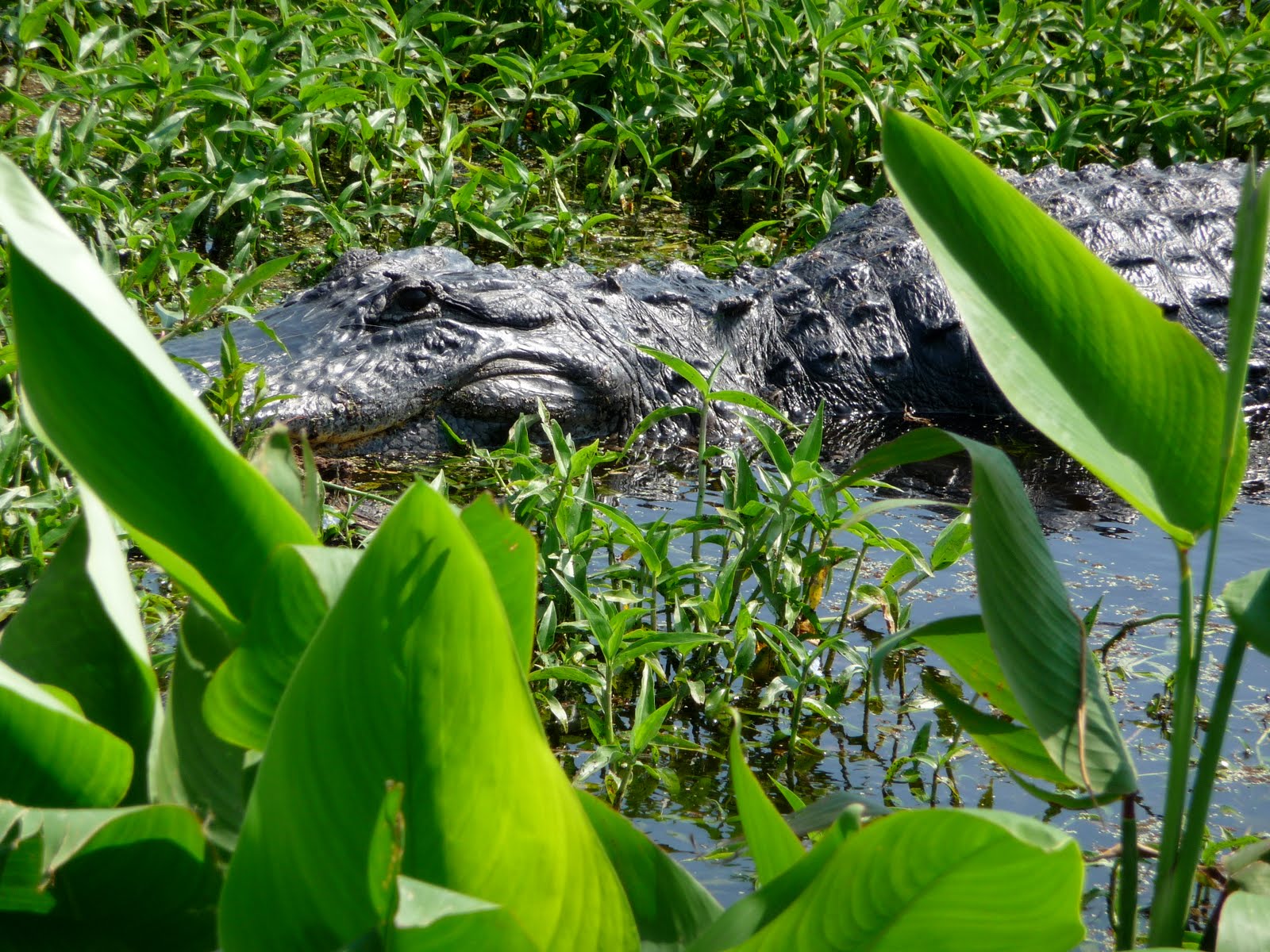
Lake Okeechobee is home to panthers, the West Indian manatee, ibises, bald eagles, river otters, bobcats, black bears, red-winged blackbirds, the Everglade snail, the Blue Heron, to name but a few. It also is home to the federally protected alligator. We got to see some babies that are about a year old and shockingly small given their age- it seems so vulnerable to stay so small for a year! Their mother, after hatching them, doesn't feed her young, but stays with them until the next mating season, which typically begins each April.

These are some adults and a camouflaged baby I challenge you to amid the greenery.


This is bladderwort, a carnivorous plant:


They capture insects by means of bladder-like traps. An aquatic species like the one at right can prey on critters as large as small tadpoles or mosquito larvae. The traps are rather sophisticated. The bladder is "set" by the flower under negative pressure relative to the water surrounding it, so when a creature swims by and brushes up against trigger hairs, the trapdoor opens and the prey and water surrounding it are swept into the bladder trap! Once the bladder is full of water, the door closes. This process takes fifteen thousandths of a second. This is a docile looking killer on the loose.
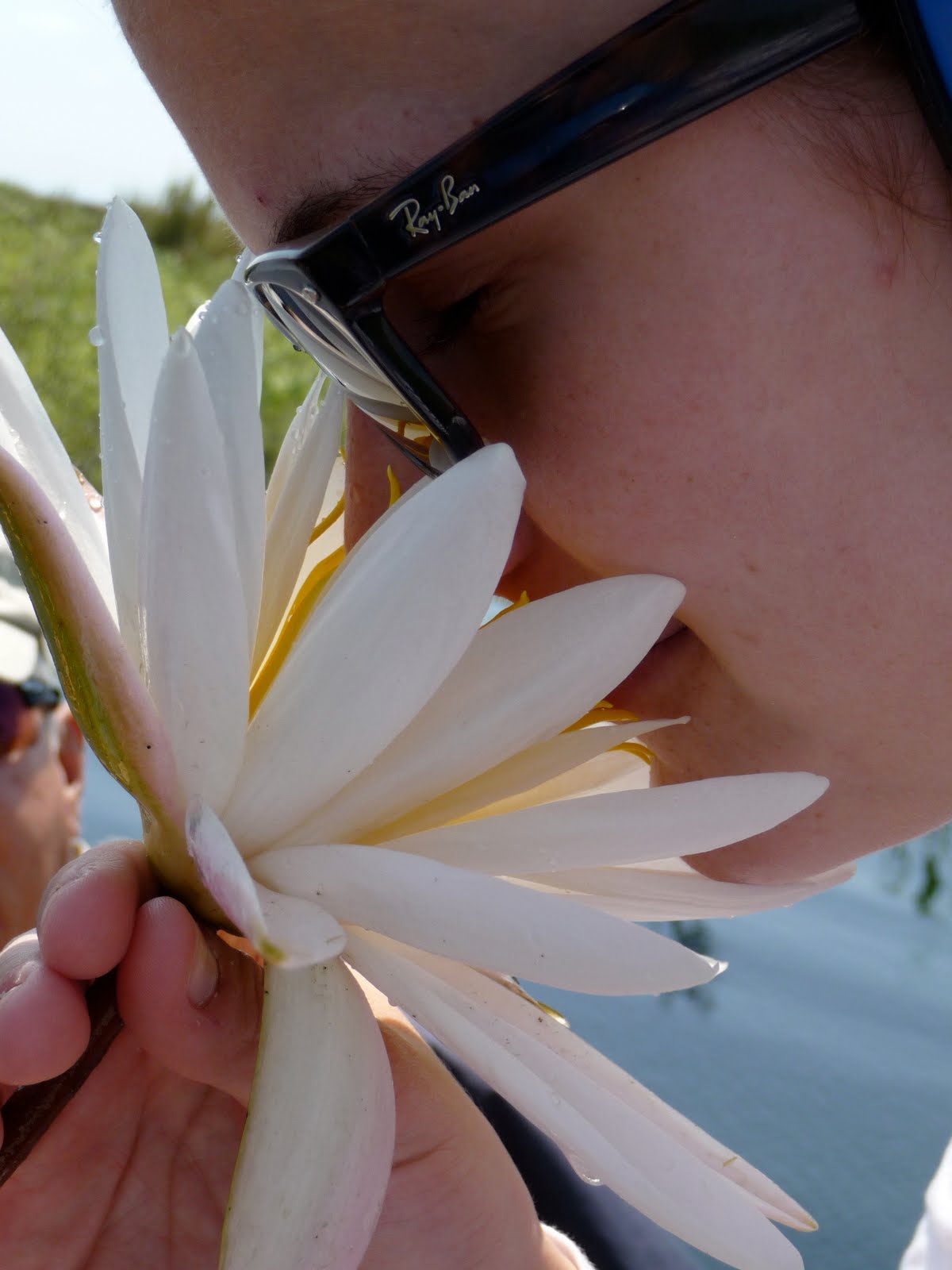
Between my legs in this dashing shot are a lotus flower, the whiter flower closer to my own flower with a yellow center, and a water lily, the more yellow flower closer to my knees. Lotuses are aquatic perennials, and under favorable conditions their seeds can stay viable and productive for many years. The oldest recorded lotus germination is from a seed 1300 years old, in a dry lakebed in China. Lotuses are hot right now, literally, because a recent study by Dr. Roger S. Seymour and Dr. Paul Schultze-Motel, physiologists at the University of Adelaide in Australia, found that lotus flowers maintained a temperature of 86 degrees Fahrenheit even when surrounding temperatures were 50 degrees. They believe this is for the benefit of their cold-blooded pollinators, and is a breakthrough case in developing studies on heat-producing plants. In both Hindu and Buddhist iconography, the Lotus is an important flower, representing purity of the body, speech and mind, and non-attachment.


Rotten papaya in the tops of trees.
Papaya, also called Paw Paw or Big Melon, has leaves that grow in a spiral pattern. When green, papaya fruit and the tree's latex generate an enzyme useful in tenderizing meat. Its fruit is soft when ripe, like an avocado. It has been cultivated in Mexico since several centuries before the emergence of Mesoamerican classic cultures. It is the first fruit tree to have its genome deciphered.


The plants above are called Water Hemlock, one of the most toxic plants in America. Our guide told us that last year in Florida a young boy made a spit gun from the stem of a water hemlock, and was nearly immediately killed.

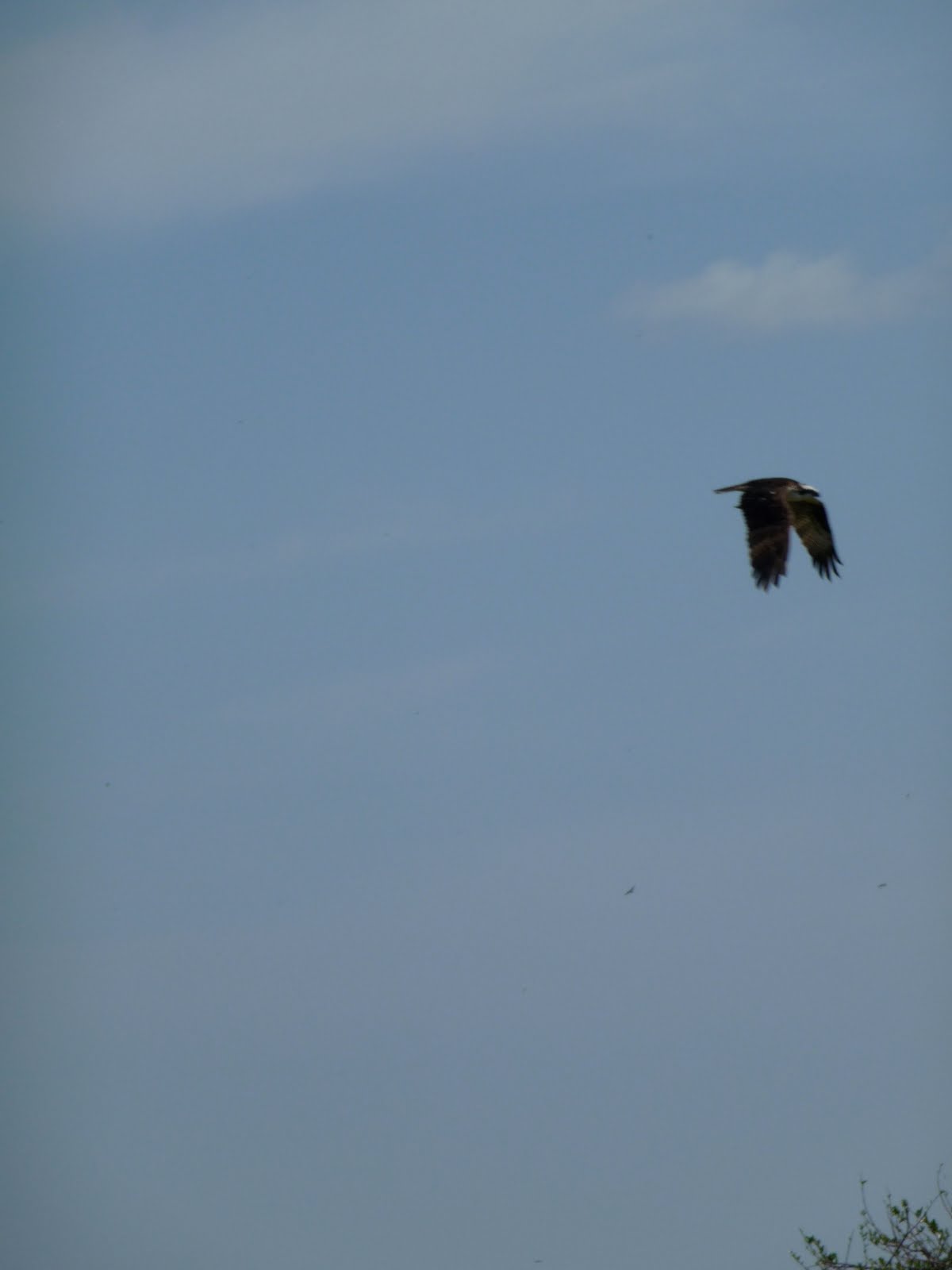
Our guide said this osprey had been hanging around this tree quite often, and if it was building a nest, it would be the first osprey nest he'd ever seen in Lake Okeechobee.
Quite a nice bird show: